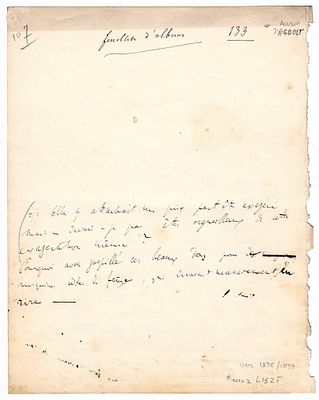
MUSIC - Franz Liszt (Doborjan, 1811- Bayreuth, 1886) - Autograph manuscript
Estimate: £2,600 - £3,000
Franz Liszt (Doborjan, 1811- Bayreuth, 1886)Autograph manuscript, not dated [1838-1839] by the celebrated Hungarian pianist. On a sheet of paper annotated “Feuillets d'Album" followed by the number "133", all in Marie d'Agoult's handwriting, the famous pianist Franz Liszt traced thefollowing text: “Elle y attachait un prix peut-être exagéré, mais ne devais-je pas être orgueilleux de cette exagération-même ? Pourquoi avoir gaspillé ces beaux dons pour de mesquines idoles de femmes qui devaient nécessairement en rire”. This page comes from a notebook (or "diary") in which Franz Liszt and Marie d'Agoult jotted down thoughts they felt were worth preserving. These few lines reveal the female rivalry that became the primary cause of the collapse of the friendship between Marie d'Agoult and George Sand. To please Franz, Marie had decided to love George, who was a close friend of Liszt, and to become her friend. But Marie's idealized image of Sand deteriorated inexorably. Franz Liszt's reflection here sums up the rivalry between the two women in a few words: he is proud to be loved by both, but considers it a shame to waste “ces beaux dons pour de mesquines idoles de femmes”, who should have been laughing. In 1866, a year marked by the final encounters of the Comtesse and Franz - they had been living apart since 1844 - the composer had come to Paris to attend the performance of his "Missa Solemnis", and Marie d'Agoult, who was ill, had decided to write her “Mémoires", which would appear after her death in 1880. To this end, she had begun to gather together all the documents needed for the composition of the work. As a result, this sheet, along with others, was detached by her from her original notebook and perhaps used in the writing of her memoirs. A rare autograph by Franz Liszt in this form, whose text suggests that a misunderstanding had arisen between the pianist and his mistress at the time of writing. Six lines on an in-8 gr. page (cm 16.5 x 21 ca.).