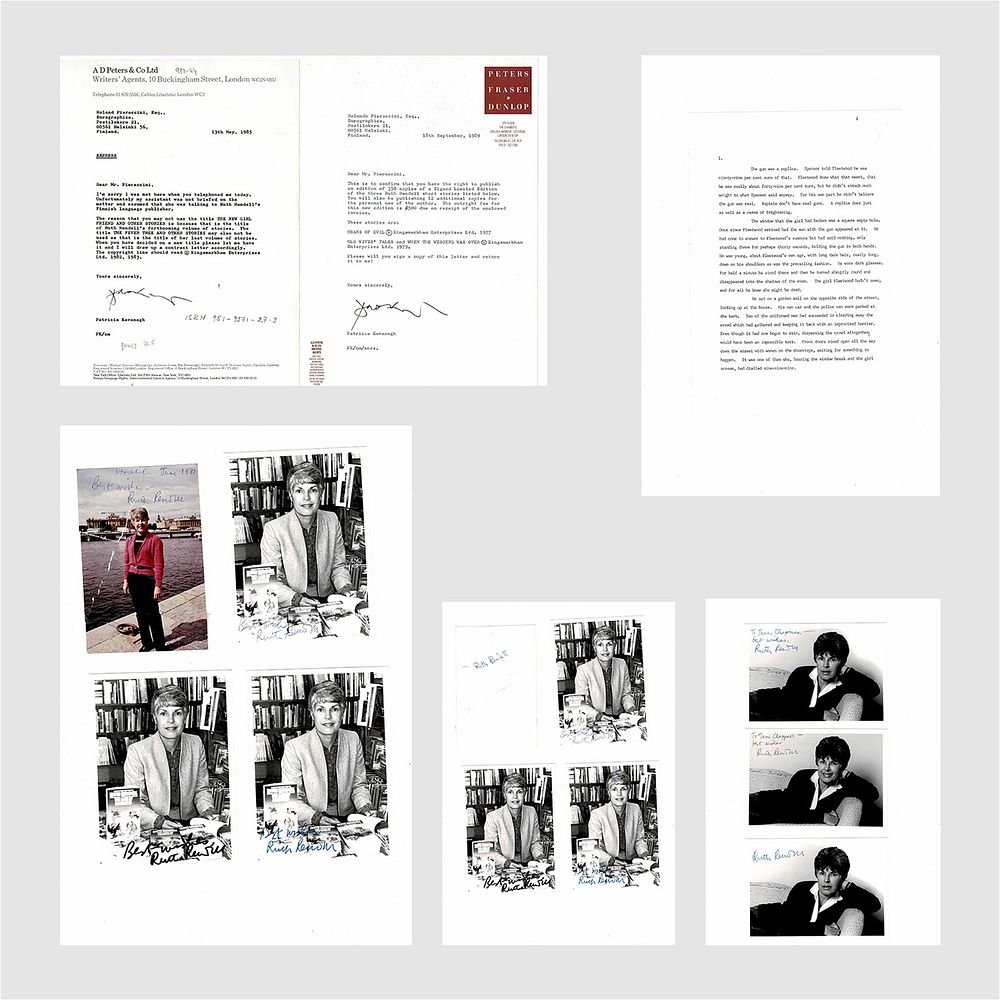
CONTEMPORARY ANGLO-AMERICAN LITERATURE - Ruth Rendell (Redbridge, 1930 - London, 2015) - A
Estimate: £1,500 - £3,500
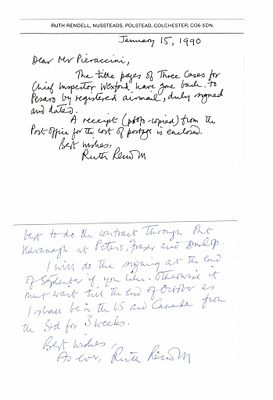
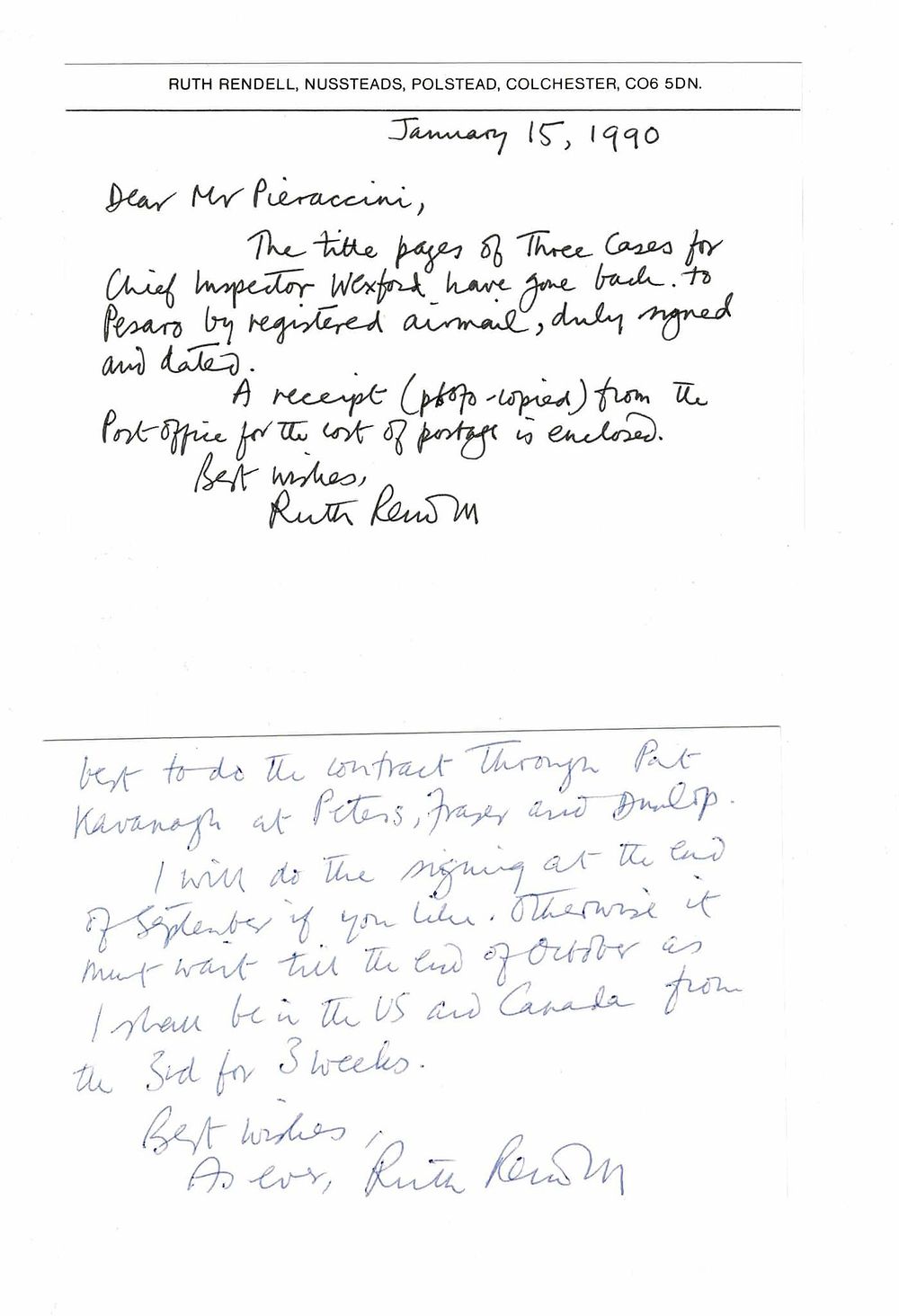
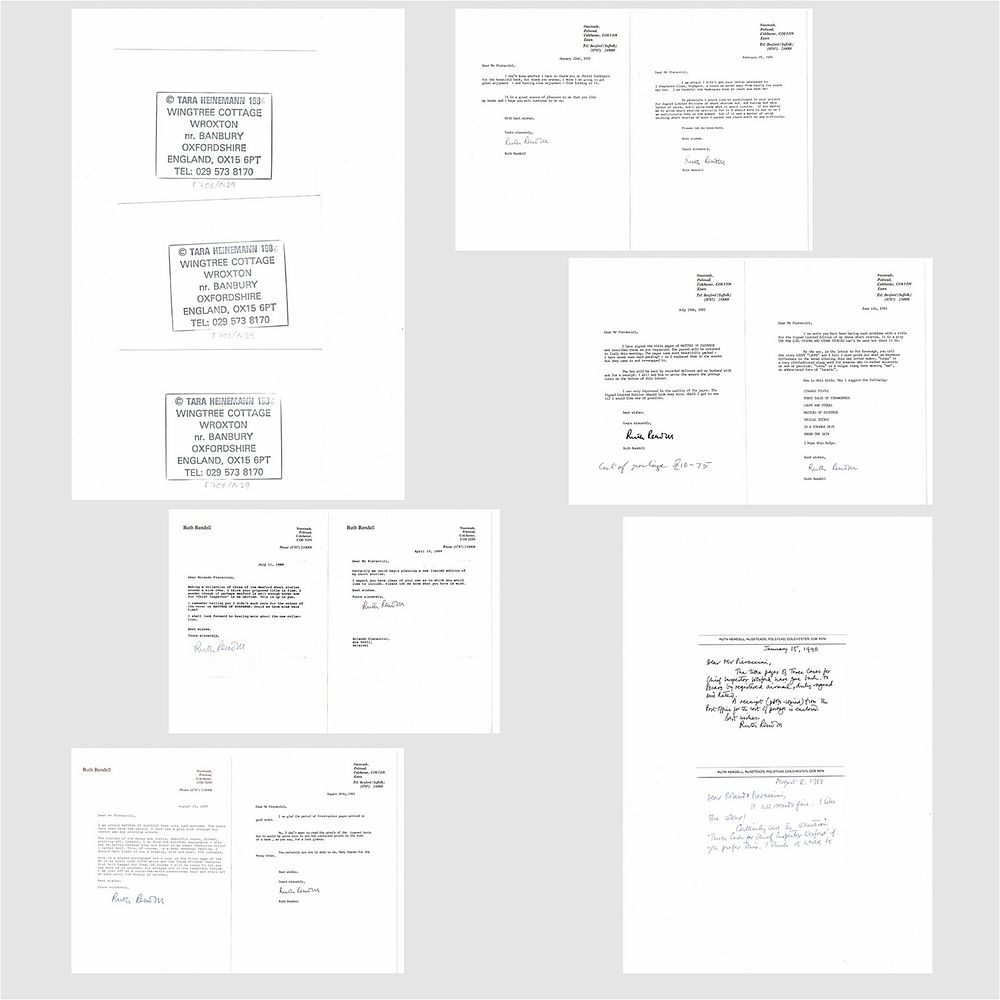
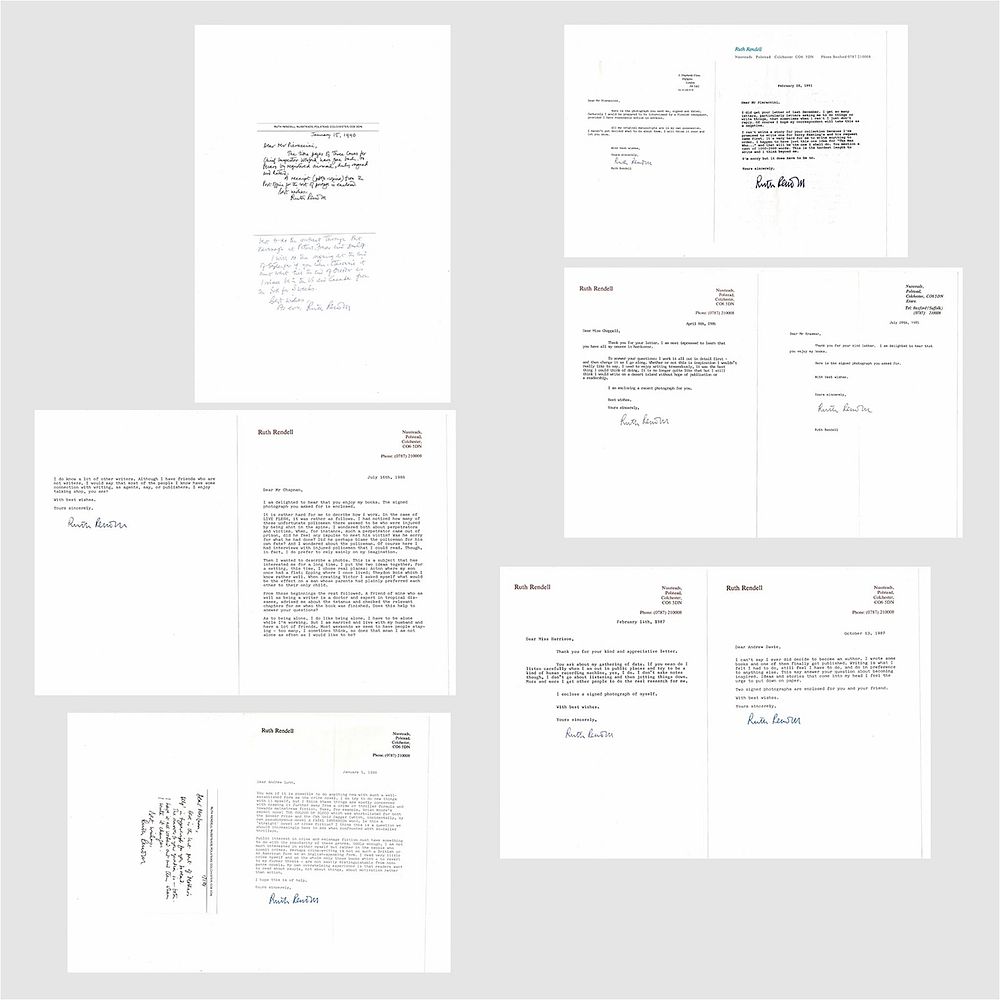
Ruth Rendell (Redbridge, 1930 - London, 2015)3 autograph letters signed; 10 typed letters signed; 18 typed letters signed and 7 photographs with autograph signature and dedication by the English author of thrillers and mystery novels, who became particularly well known for her novels featuring characters such as the Chief Inspector Wexford. The letters provide insight into how she dealt with publishers, her decisions on volume titles and in some cases how she became a writer and how she goes about her work.Three autograph letters signed 17. 1. 88. To Andrew Lunn: "Here is the last part of ‘Mother’s Help’ in typescript for you to read. The answer to your question is – both. I have it all worked out and then when I write it changes". 1 p., on postcard with author’s letterhead.August 8, 1989. To Rolando Pieraccini, regarding the forthcoming publication of the edition of Three Cases for Chief Inspector Wexford (1990), one of the series of fine limited copies of her works edited by Eurographica: "It all sounds fine. I like the colour! Certainly call the correction 'Three Cases for the Chief Inspector Wexford' if you prefer this! (...) I think it would be best to do the contract through Pat Kavanagh at Peter’s, Fraser and Dunlop. I will do the signing at the end of September if you like". 2 pp., on postcard with author’s letterhead.January 15, 1990. Announcing to Pieraccini that: "the title pages of Three Cases for Chief Inspector Wexford have gone back to Pesaro by registered airmail, duly signed and dated". 1 p., on postcard with author’s letterhead.Ten typed letters signed to the publisher Rolando Pieraccini n.d - [1981?]: "Certainly I would be prepared to be interviewed by a Finnish newspaper (...) All my original manuscripts are in my own possession. I haven’t yet decided what to do about them. I will think it over and let you know". 1 p., on the author’s letterhead.February 28, 1985. Agrees with Pieraccini’s idea of publishing: "Signed Limited Editions of short stories". 1 p., on the author’s letterhead.June 4th, 1985 – on the author’s letterhead – 1 p. Rendell argues against Pieraccini’s title suggestions for the signed limited edition publication: "In the letter to Pat Kavanagh, you call the story 'LOOPY LOONY' and I felt I must point out what an enormous difference to the sense altering this one letter makes. 'Loopy' is a very old-fashioned slang word for someone who is a rather eccentric or odd or peculiar. ‘Loony’ is a vulgar slang term meaning 'mad', an abbreviated form of 'lunatic'". She then ventures some titles: "May I suggest the following: STRANGE PEOPLE/THREE TALES OF STRANGENESS/LOOPY AND OTHERS/MATTER OF SUSPENSE/ UNUSUAL THINGS/IN A STRANGE SKIN/UNDER THE SKIN".July 19th, 1985. Notifying that she has: "signed the title pages of MATTERS OF SUSPENSE and inscribed three as you requested (...) I was very impressed by the quality of the paper. The Signed Limited Edition should look very nice. Shall I get to see it? I would like one if possible". 1 p., on the author’s letterhead.August 28th, 1985. Acknowledging the safe arrival of the signed frontispieces and answers Pieraccini’s queries: "No, I don’t want to read the proofs of the typeset texts but it would be quite nice to see the corrected proofs in the form of a book, as you say, for a last glance". 1 p., on the author’s letterhead.August 24, 1987. Reviewing the copy of her Matter of Suspense: "The insides of the books are lovely, beautiful paper, format, printing etc. However, I do find the external appearance – this may be partly because they are bound in my least favourite colour – rather dull. This, of course, is a very personal feeling, I should have liked to see a drawing, line and wash, for instance". She then encloses a "copy of the first page of the MS of my novel LIVE FLESH which won the Crime Writers’ Association Gold Dagger for 1986. Of course I will be happy to let you use more of my stories, but perhaps not in the immediate future". Typed page of the first chapter of Live Flesh (1986) included. 1 p., on the author’s letterhead.April 10, 1989. Agrees with Pieraccini on planning a new signed limited edition of short stories: "I expect you have ideas of your own as to which you would like to include. Please let me know what you have in mind". 1 p., on the author’s letterhead.July 11, 1989. Rendell and Pieraccini had reached an agreement on the new limited edition: "Making a collection of three of the Wexford short stories sounds a nice idea. (...) I remember telling you I didn’t much care for the colour of the cover on MATTERS OF SUSPENSE. Could we have blue this time?". 1 p., on the author’s letterhead.February 20, 1991. Pieraccini asks Rendell to write a story for his collection, she answers refusing as she "promised to write one for Harry Keating’s and his request came first. It’s very hard for me to write anything to order". 1 p., on the author’s letterhead.Two typed letters signed by Ruth Rendell’s agent Patricia Kavanagh.13th May, 1985. Kavanagh replies to Pieraccini explaining why he can’t use certain titles for his collection of her stories: "THE NEW GIRL FRIEND AND OTHER STORIES because that is the title of Ruth Rendell’s forthcoming volume of stories. The title THE FEVER TREE AND OTHER STORIES may also not be used as that is the title of her last volume of stories...". The publication she refers to is Matters of Suspense (Eurographica, 1983). 1 p., on A D Peters & Co letterhead.18th September, 1989. Kavanagh writes to Pieraccini notifying him that he has "the right to publish an edition of 350 copies of a Signed Limited Edition of the three Ruth Rendell short stories (...) These stories are: MEANS OF EVIL © Kingsmarkham Enterprises Ltd. 1977/ OLD WIVES’ TALES and WHEN THE WEDDING WAS OVER © Kingsmarkham Enterprises Ltd. 1979". 1 p., on Peter Fraser & Dunlop letterhead.Six typed letters signed July 26th 1985. To Elliott Kraemer, sending him a signed photograph. With printed address of the author at the head – 1 pApril 8th, 1986. To Jane Chappell, who was enquiring as to her working method: "I work it all out in detail first - and then change it as I go along. Whether or not this is inspiration I wouldn’t really like to say. I used to enjoy writing tremendously, it was the best thing I could think of doing (...) I still think I would write on a desert island without hope of publication or readership". 1 p., on the author’s letterhead.July 16th, 1986. Answering a few questions for James Chapman on how she develops ideas for her writings: "In the case of LIVE FLESH, it was rather as follows. I had noticed how many of these unfortunate policemen there seemed to be who were injured by being shot in the spine. I wondered both about perpetrators and victims. (...) Though, in fact, I do prefer to rely mainly on my imagination. (...) For a setting, this time, I chose real places (...) A friend of mine who as well as being a writer is a doctor and expert in tropical diseases, advised me about the tetanus and checked the relevant chapters for me". 2 pp., on the author’s letterhead.February 14th, 1987. To Miss Harrison, providing indications on how she gathers information for her work : "If you mean do I listen carefully when I am out in public places and try to be a kind of human recording machine, yes, I do. I don’t make notes though, I don’t go about listening and then jotting things down. More and more I get other people to do the real research for me". 1 p., on the author’s letterhead.October 13, 1987. To Andrew Davie. Rendell discusses how she became a writer: "Writing is what I felt I had to do, still feel I have to do, and do in preference to anything else. This may answer your question about becoming inspired. Ideas and stories that come into my head I feel the urge to put down on paper". 1 p., on the author’s letterhead.January 5, 1988. To Andrew Lunn, who had asked an intriguing question about how the crime novel as a form might be transformed: "I do try new things with it myself, but I think these things are mostly concerned with drawing it further away from a crime or thriller formula and towards mainstream fiction. (...) Public interest in crime and es[p]ionage fiction must have something to do with the popularity of these genres. Oddly enough, I am not much interested in either myself but rather in the people who commit crimes. (...) My own overwhelming experience is that readers want to read about people, not about things, about motivation rather than action". 1 p., on the author’s letterhead.Typed extract of the first chapter of the novel Live Flesh (1986)Seven photographic potraits with dedication signed. x3 (17.5 x 12.5 cm); x3 (12 x 16 cm); x1 (10 x 15 cm).