CONTEMPORARY ANGLO-AMERICAN LITERATURE - Arthur Miller (New York, 1915 - Roxbury, 2005) - A
Estimate: £7,000 - £8,000
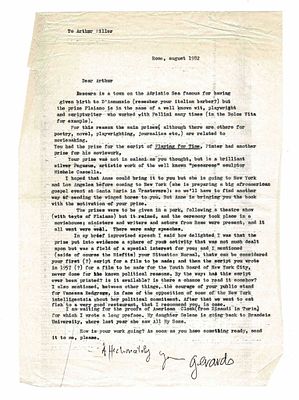
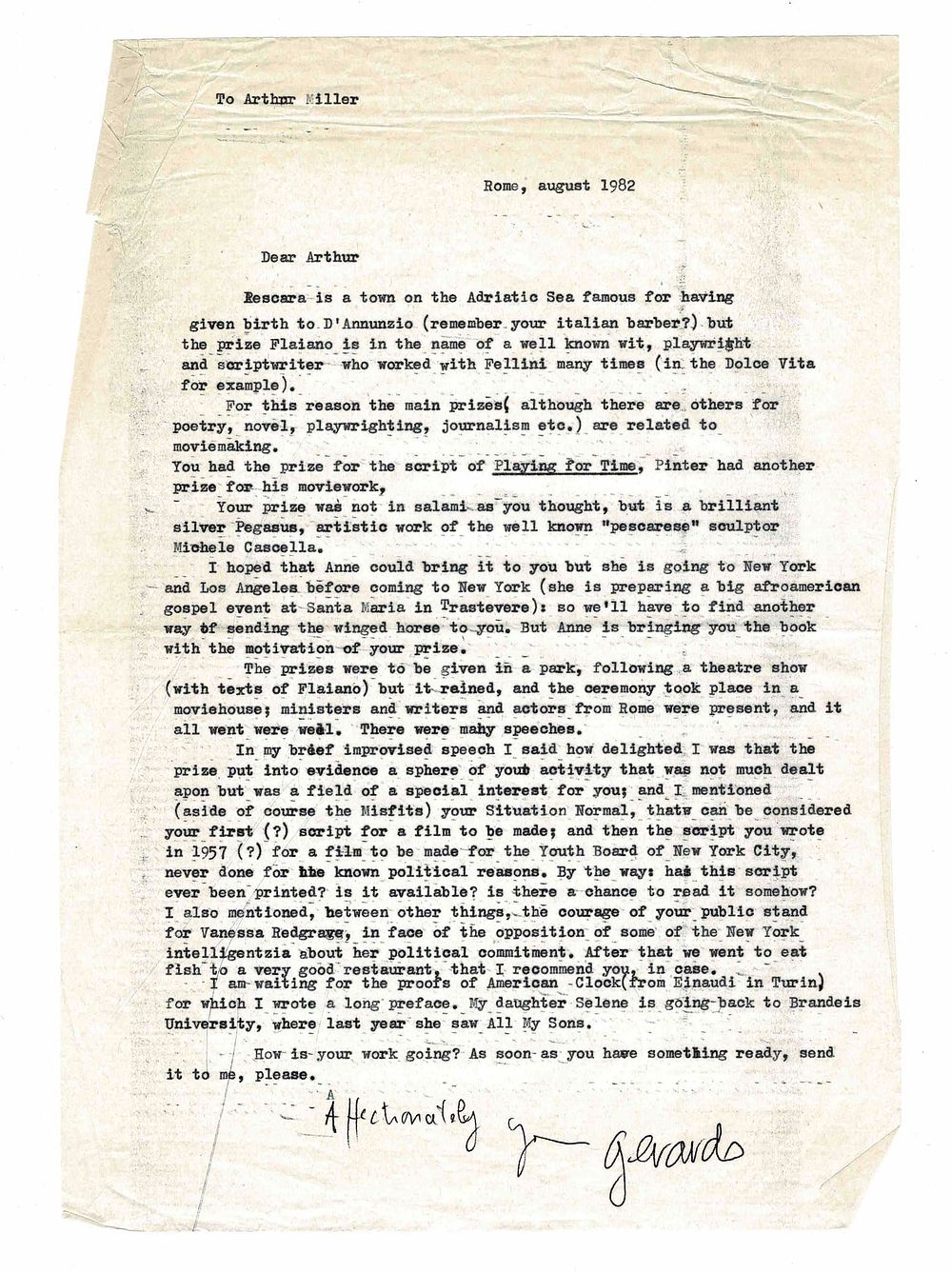
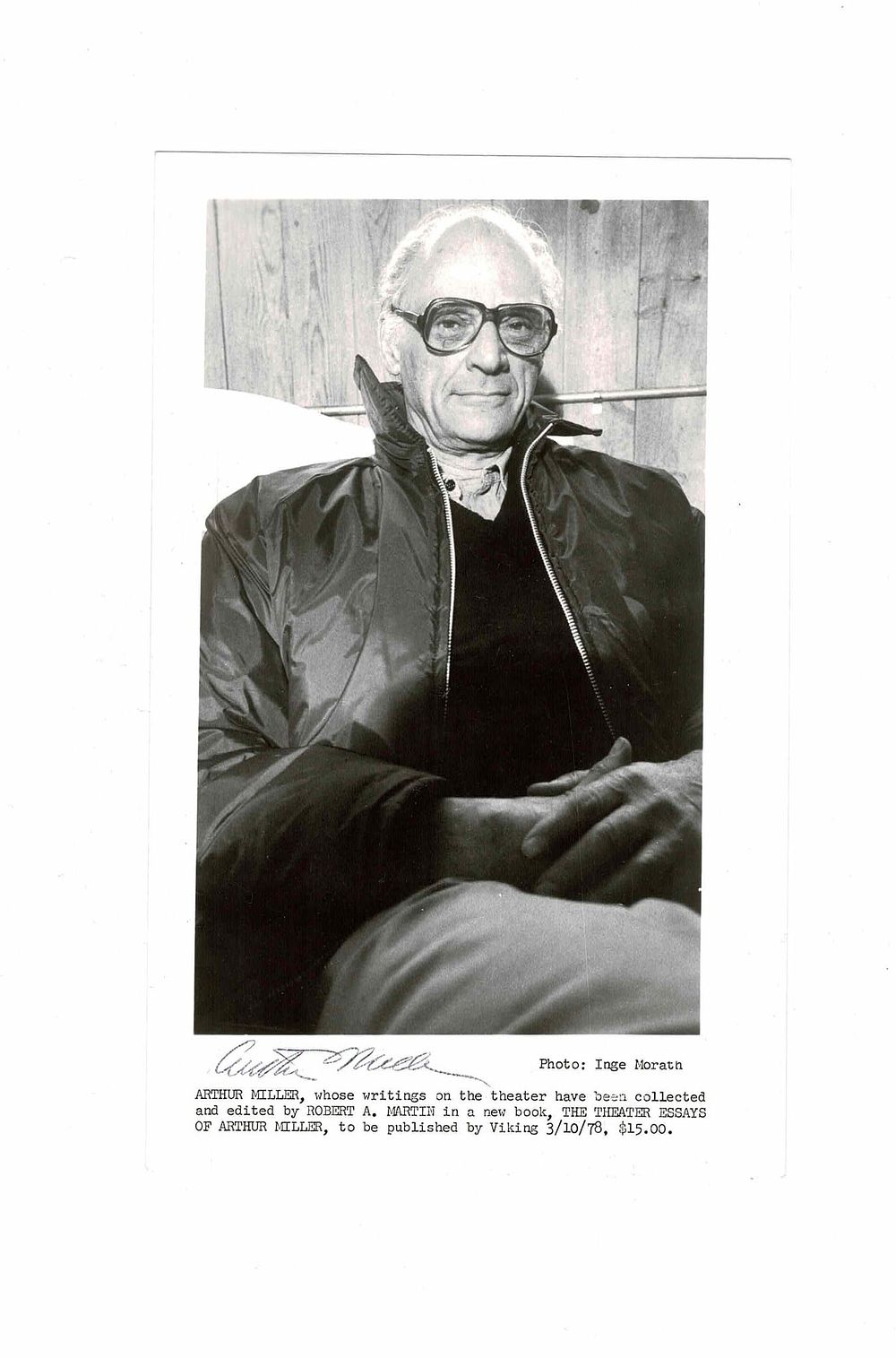
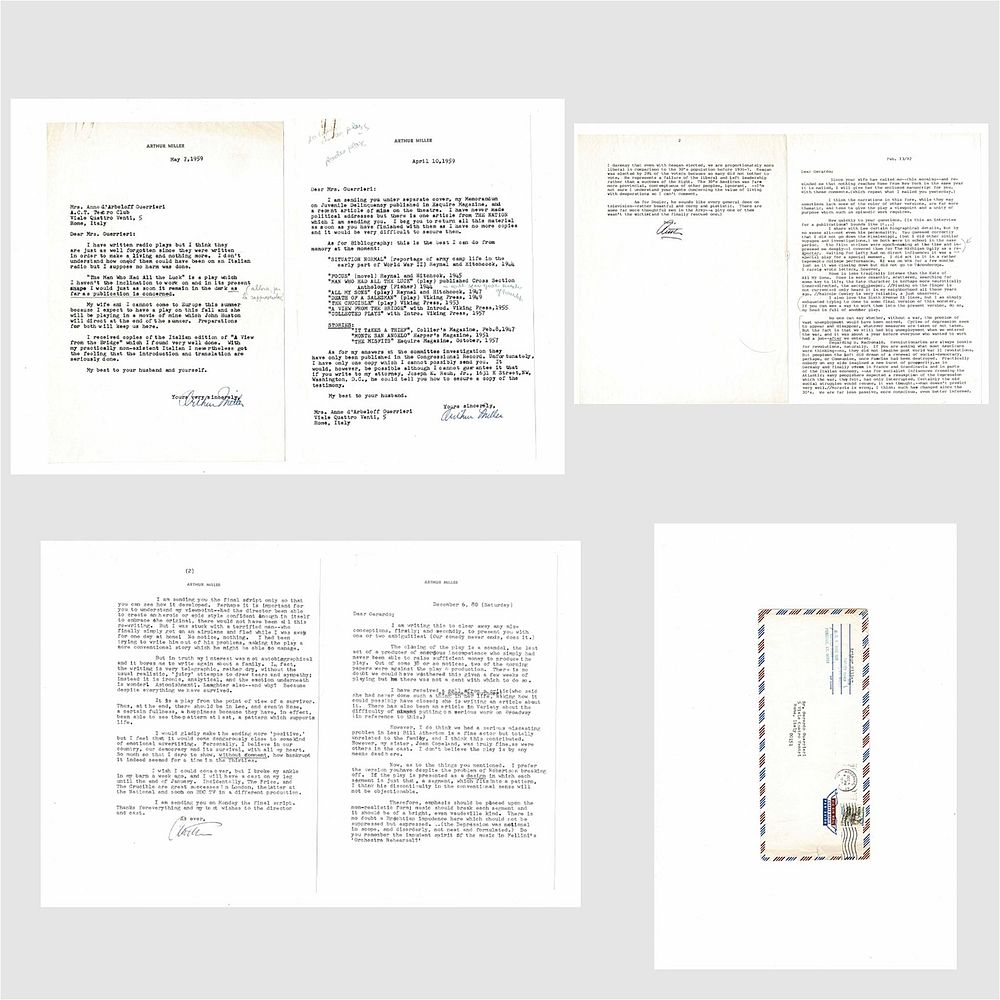
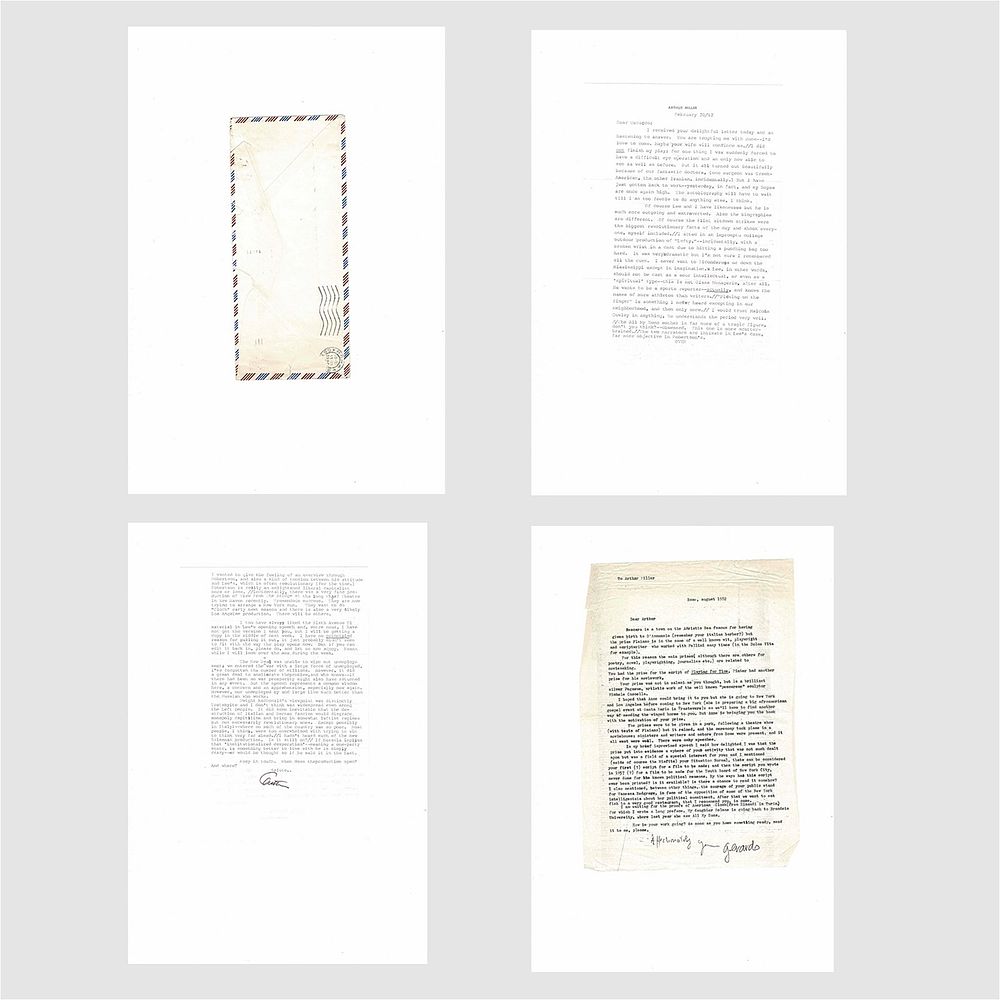
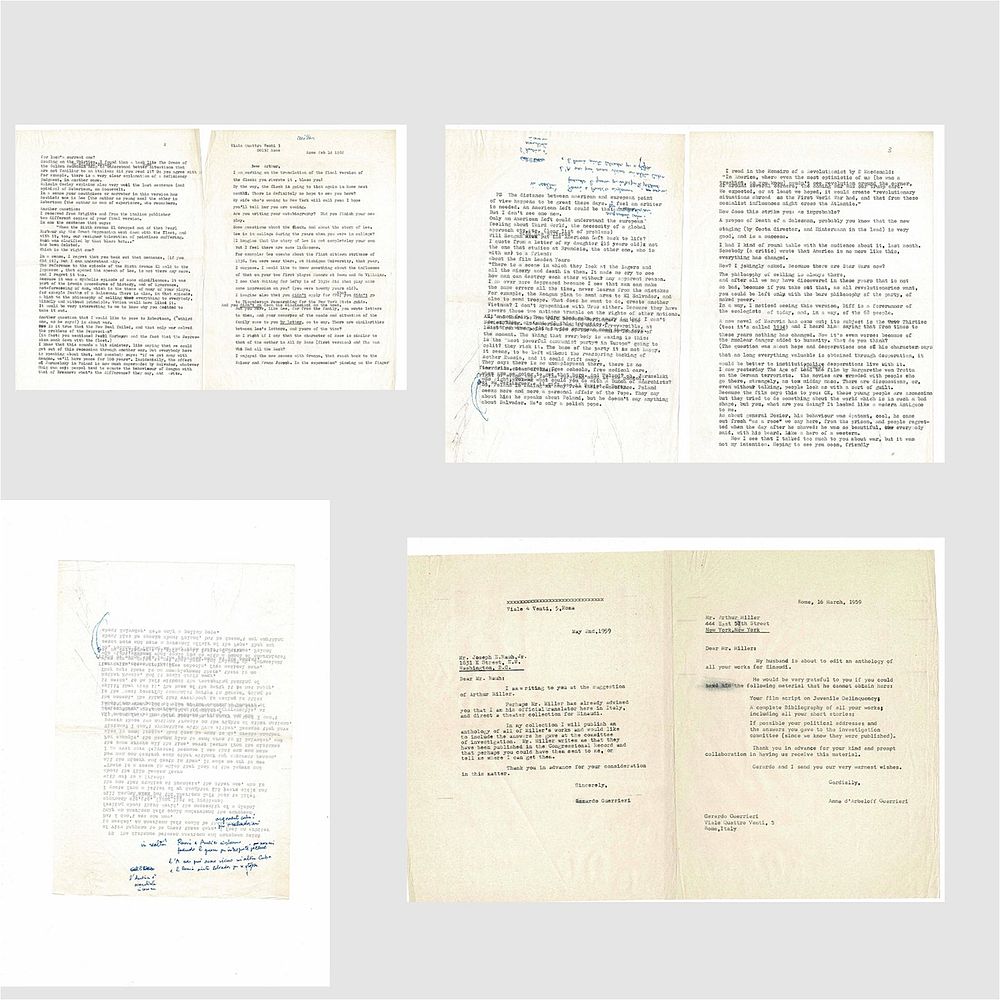
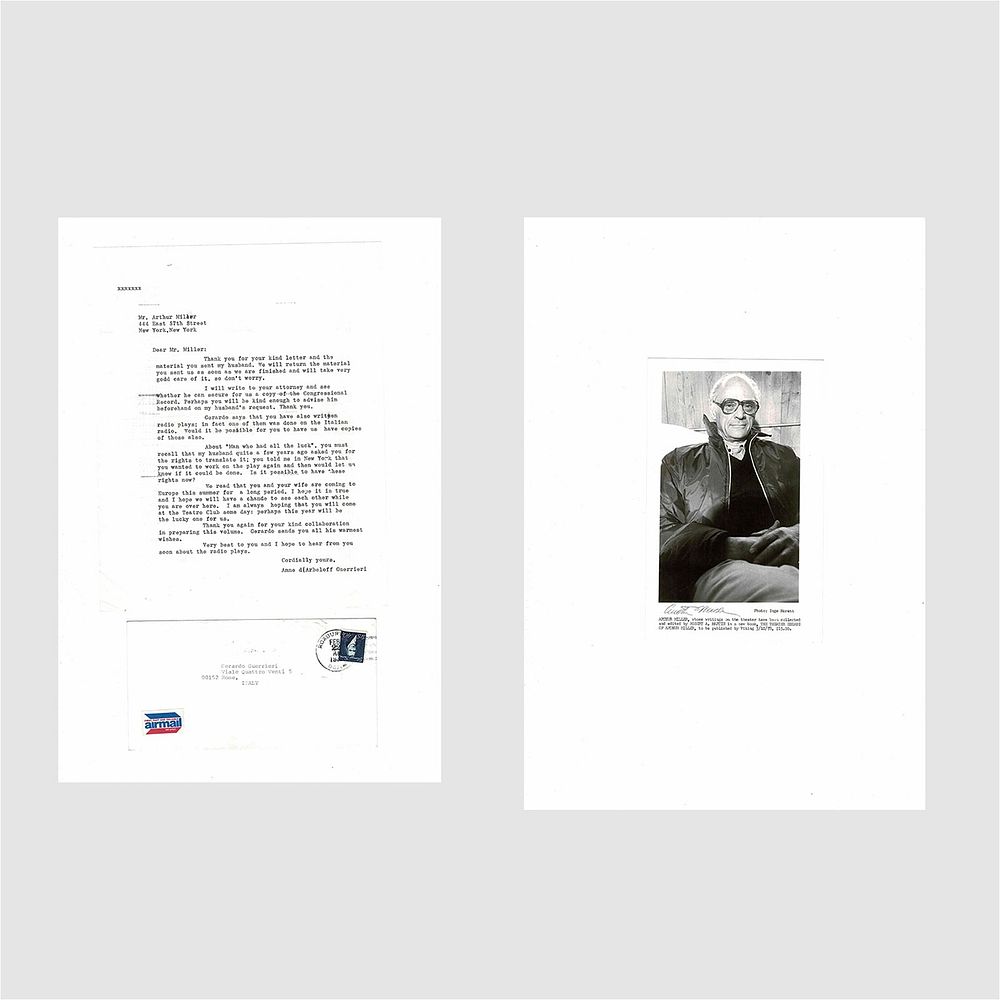
Arthur Miller (New York, 1915 - Roxbury, 2005)5 typed letters signed; 5 typed letters from Gerardo Guerrieri and Anne d’Arbeloff; 1 photograph signed.Miller was an American playwright and essayist. Often in the public eye, he was awarded many prizes during his career. His play Death of a Salesman (1949) was awarded the Pulitzer Prize for Drama and listed in the finest American plays of the 20th century.Five typed letters signed to Gerardo Guerrieri (1920-1986) and his wife Anne d’Arbeloff Guerrieri, who together founded the Teatro Club in 1957, an international association for the promotion and development of theatre culture. The correspondence concerns the Italian publication of A View from the Bridge, edited by Gerardo Guerrieri and Renzo Rossellini and published by Ricordi in 1961, the staging of The American Clock (1980) and hints to political relevance.April 10, 1959. "I am sending you under separate cover, my Memorandum on Juvenile Delinquency published in Esquire Magazine, and a recent article of mine on the theatre. I have never made political addresses but there is one article from THE NATION which I am sending you". 1 p. on the author’s letterhead.May 7, 1959. "I have written radio plays but I think they are just as well forgotten since they were written in order to make a living and nothing more (...)The Man Who Had All the Luck is a play which I haven’t the inclination to work on and in its present shape I would just as soon it remain in the dark as far as publication is concerned (...) I received copies of the Italian edition of A View from the Bridge which I found very well done. With my practically non-existent Italian I nevertheless got the feeling that the introduction and translation are seriously done". 1 p. on the author’s letterhead.December 6, 80 (Saturday). Concerning the translation of the play The American Clock, translated and premiered at Teatro Duse in Genova in January 1981: "The closing of the play is a scandal, the last act of a producer of enormous incompetence who simply had never been able to raise sufficient money to produce the play. Out of some 38 or so notices, two of the morning papers were against the play & production (...) I do think we had a serious miscasting problem in Lee; Bill Atherton is a fine actor but totally unrelated to the family, and I think this contributed. However, my sister, Joan Copeland, was truly fine, as were others in the cast. I don’t believe the play is by any means dead here (...) I am sending you the final script only so that you can see how it developed (...) It is a play from the point of view of a survivor. Thus, at the end, there should be in Lee, and even in Rose, a certain fullness, a happiness because they have, in effect, been able to see the pattern at last, a pattern which supports life". 2 pp. on the author’s letterhead.Feb 13/82. Giving an interview, mentioning contemporary authors such as Harper Lee, Malcolm Cowley, John D. MacDonald: "I share with Lee certain biographical details, but by no means all – not even his personality. You guessed correctly that I did not go down the Mississippi. (...) The Flint strikes were epoch- making at the time and impressed me deeply – I covered them for the Michigan Daily as reporter (...) Malcom Cowley is very reliable, a just observer (...) No one can say whether, without a war, the problem of vast unemployment would have been solved. Cycles of depression seem to appear, whatever measures are taken or not taken. But the fact is that we still had big unemployment when we entered the war, and it was about a year before everyone who wanted to work had a job–after we entered. Regarding John D. MacDonald. Revolutionaries are always looking for revolutions, naturally. If you are asking what most Americans were thinking–no, they did not imagine post World War II revolutions. But people on the Left did dream of a renewal of social-democracy, perhaps, or Communism, once Fascism had been destroyed (...) As for Dozier, he sounds like every general does on television – rather boastful and corny and pietistic. There are some far more thoughtful men in the Army – a pity one of them wasn’t the victim (and the finally rescued one)". Army officer James L. Dozier, kidnapped the year before by the Italian Red Brigades is mentioned. 1 p. ½.February 20/82. "I did not finish my play; for one thing I was suddenly forced to have a difficult eye operation and am only now able to see as well as before (...) Of course Lee and I have likenesses but he is much more outgoing and extroverted. Also the biographies are different. Of course the Flint sitdown strikes were the biggest revolutionary facts of the day and shook everyone, myself included". 2 pp. on the author’s letterhead. Envelope included.Five typed letters, just one of them signed, from Gerardo Guerrieri and his wife Anne d’Arbeloff Guerrieri. One letter is addressed to America’s foremost civil rights lawyer Joseph L. Rauh Jr. (1911-1992).May 2nd, 1959. To Joseph L. Rauh Jr: "Perhaps Mr. Miller has already advised you that I am his official translator here in Italy (...) I will publish an anthology of all of Miller’s works and would like to include the answers he gave to the commitee of investigation. Mr. Miller writes me that they have been published in the Congressional Record and that perhaps you could have them sent to me". 1 p.Rome 16, March, 1959. From Anne d’Arbeloff Guerrieri: "My husband is about to edit an anthology of all your works for Einaudi. He would be very grateful to you if you could send him the following material that he cannot obtain here: Your film script on Juvenile Delinquency; A complete Bibliography of all your works; including all your short stories". 1 p.Rome, feb 14 1982. Guerrieri asks some questions to the author of The American Clock: "Some questions about the Clock. And about the story of Lee. Lee is in college during the years when you were in college? (I imagine that the story of Lee is not completely your own but I feel there are some likenesses) (...) Reading the Thirties, I found that a book like The Dream of the Golden Mountain by Malcolm Cowley helps to understand better some situations that are not familiar to an Italian: did you read it? Do you agree with for example, there is a very clear explanation of a deficiency judgment (...) Another question that I would like to pose to Robertson, (a third one, he says!) is about war. Is it true that the New Deal failed, and that only war solved the problems of the Depression? (...) The distance between American and European point of view happens to be great these days. I feel an arbiter is needed. An American Left could be that answer. But I don’t see one now". 4 pp. with autograph annotations.Rome, august 1982. Telling the Flaiano Prizes ceremony, where Miller won the prize for the script of Playing for Time. Guerrieri describes the soirée: "The prizes were to be given in a park, following a theatre show (with texts of Flaiano) but it rained, and the ceremony took place in a moviehouse (sic); ministers and writers and actors from Rome were present, and it all went were [sic] well. There were many speeches. In my brief improvised speech I said how delighted I was that the prize put into evidence a sphere of your activity that was not much dealt apon [sic] but was a field of a special interest for you; and I mentioned your Situation Normal, that can be considered your first (?) for a film to be made for the Youth Board of New York City". 1 p. with autograph signature.[postmarked Feb 22 1982]. From Anne d’Arbeloff Guerrieri: "Gerardo says that you have also written radio plays; in fact one of them was done on the Italian radio. Would it be possible for you to have us have copies of those also (...) About Man who had all the luck, you must recall that my husband quite a few years ago asked you for the rights to translate it; you told me in New York that you wanted to work on the play again and would let us know if it could be done. Is it possible to have these rights now?". 1 p. Envelope included.Photographic portrait with autograph signature (1978 circa). Photograph by the American photographer Inge Morath (1923-2002). (12.5 x 20.5 cm).